
TPO vs. EPDM Roofing
Membrane Roofing Systems
 Let’s take a look at the fundamental differences between TPO and EPDM roofing systems. We see these two options dominate the market for commercial and flat-roof applications across Oklahoma.
Both of these abbreviations represent high-performance roofing systems popular for a variety of commercial buildings. From churches and condos to retail stores, low-slope facilities are almost always built or converted using either a TPO roof or an EPDM roof.
Note: This post was originally published in April 2022 and has been fully updated in 2026.
If you are trying to decide on a new roofing system, you are likely looking for a solution that provides long-term durability with fewer maintenance headaches over the years. Our goal is to help you understand which membrane fits your specific building needs and budget in the current 2026 market.
In this post, we will cover:
- How TPO and EPDM systems are engineered and installed.
- Key factors that building owners and facility managers must consider.
- Which system offers the best energy efficiency and ROI for your property.
As always, if you need professional guidance or a direct inspection for your roof, reach out to us. We are here to ensure your investment is protected.
Key Advantages of Commercial Membrane Roofing Systems
A membrane roofing system, such as EPDM or TPO, is a high-performance material specifically engineered for flat or low-slope roofs. We typically install these systems on commercial buildings where traditional shingles are not an option.
Both membranes are durable and cost-effective roof options for your commercial building. However, one may offer specific benefits for your building’s orientation, local climate, or chemical exposure. In 2026, we are seeing these materials become even more popular due to their adaptability and high resistance to UV radiation.
Both TPO and EPDM can be installed significantly faster than commercial metal roofing. This efficiency allows us to save you a substantial amount on labor costs while ensuring your business remains operational during the project.
Key Takeaways for Membrane Roofing:
- Installation Speed: Much faster than metal or built-up systems.
- Weight: Lightweight materials that put less stress on your building’s structure.
- Cost: High ROI compared to traditional asphalt or metal alternatives.
NEED HELP? CALL PRO-TECH ›› (918) 250-7663
What is TPO Roofing?
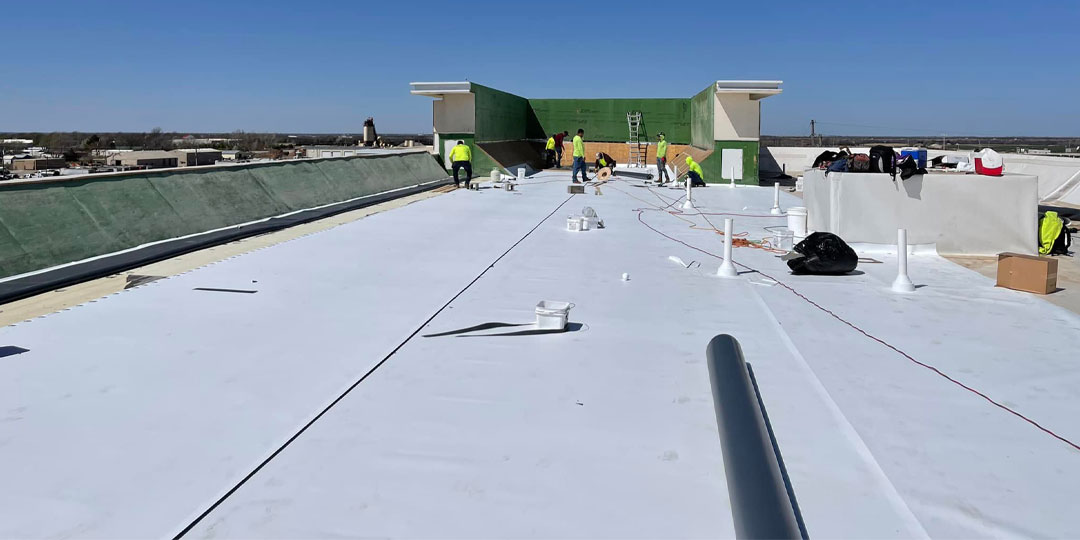
What does TPO roofing stand for? TPO is an acronym for Thermoplastic Polyolefin. It is a single-ply roofing membrane that serves as a highly effective solution for low-slope or flat roofs.
As of 2026, TPO remains the most popular choice in the commercial industry, holding the largest market share among single-ply systems. While the membrane itself is lightweight, we install it over a solid substrate—typically a rigid insulation system—to ensure maximum performance.
[Image of TPO membrane cross-section showing top, middle, and base layers]
The membrane is available in various thicknesses, typically ranging from 45-mil to 90-mil. For most Oklahoma commercial properties, we recommend a 60-mil or 80-mil thickness to better withstand our local weather extremes. A standard TPO membrane consists of three distinct layers:
- TPO Top Layer: Includes UV blockers and abrasion-resistant compounds to prevent solar degradation.
- TPO Middle Layer: A strong polyester mesh (scrim) that provides the membrane’s core strength and structure.
- TPO Base Layer: Engineered with flexibility and adhesion compounds for a secure fit.
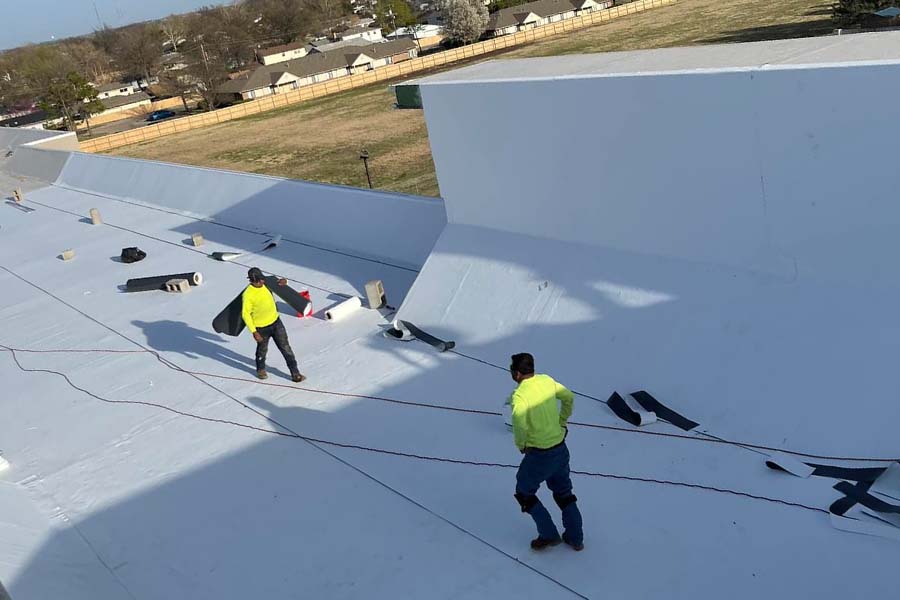
We also offer fleece-backed TPO for applications requiring extra cushion or enhanced wind uplift resistance. We secure these systems using mechanical fasteners, specialized adhesives, or heat welding—the latter of which creates a permanent, monolithic seal across your entire roof.
What is EPDM Roofing?
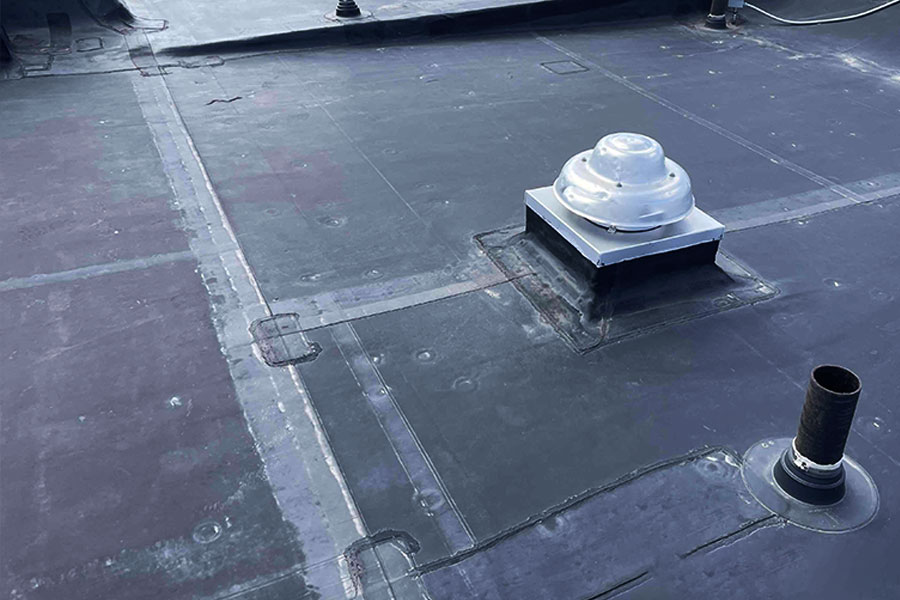
What does EPDM roofing stand for? EPDM stands for Ethylene Propylene Diene Monomer. Many of our clients simply refer to this as “rubber roofing” because of its synthetic rubber composition.
Like TPO, EPDM is a single-ply system. It is a time-tested material that has been a staple in the industry since the 1960s. The standard EPDM membrane is also constructed with three functional layers:
- EPDM Top Layer: Fiber-reinforced polyester for surface protection.
- EPDM Middle Layer: A specialized fire-retardant compound.
- EPDM Base Layer: A high-performance elastomeric layer that allows the roof to expand and contract.
[Image of EPDM roofing membrane layers]
While standard EPDM is black, we can install white-topped EPDM to help reflect heat. EPDM membranes are manufactured in long, wide sheets, making them ideal for covering large surfaces quickly. Common thicknesses in 2026 are 45, 60, and 90 mils. In our experience, thicker membranes offer significantly better protection against Oklahoma hail and wind events.
How are TPO and EPDM Roofs Made?
At the most basic level, a TPO roofing membrane is a plastic-based product, while an EPDM roof is a rubber-based product. This difference in base material dictates how the roof performs over time.
With TPO, the polymer materials are chemically adjusted to provide maximum impact resistance and tensile strength. Because TPO is a thermoplastic, it remains pliable during installation but hardens into a rigid, protective shell that resists UV rays and chemical exposure better than almost any other material.
With EPDM, the synthetic rubber is compounded to prioritize elasticity. This allows the roof to stretch and move with your building as temperatures fluctuate. Modern EPDM formulations are highly resistant to thermal shock, meaning they can handle a 40-degree temperature drop in a single afternoon without cracking.
The Benefits of TPO Roofing
TPO offers several key advantages for modern commercial properties. Here is why we often recommend it:
- Puncture Resistance: TPO’s reinforced mesh layer offers superior protection against punctures compared to non-reinforced systems.
- Energy Efficiency: The white surface of TPO reflects up to 80% of solar radiation. This can reduce your cooling costs by 20% to 30% during hot Oklahoma summers.
- Lifetime Value: In 2026, TPO remains one of the most cost-effective systems. TPO installation is efficient, and flat roof repairs are usually straightforward.
- Resists Shrinkage: Unlike some older rubber systems, TPO is extremely stable and does not shrink, which protects the integrity of your seams.
- Monolithic Membrane: By heat-welding the seams, we create a single, unbroken waterproof barrier across your entire facility.
The Benefits of EPDM Roofing
EPDM continues to be a top-tier choice for specific applications. Here are the primary benefits we see with EPDM:
- Fast Installation: EPDM arrives in massive rolls, allowing us to cover large square footage with fewer seams in a shorter timeframe.
- Simple Maintenance: While seams may need attention every 10-15 years, the membrane itself is incredibly easy to patch if it ever sustains a puncture.
- Proven Durability: EPDM has the longest track record in the industry. We regularly see EPDM roofs that are still performing well after 25 or 30 years.
- Weather Resilience: Because it is rubber-based, EPDM remains flexible in sub-zero temperatures, making it less prone to winter damage.
- Cost-Effective Upfront: EPDM material costs often range between $10 and $20 per square foot installed, making it an attractive option for budget-conscious projects.
Replace Your Roof With a Single-Ply Membrane
If you have a flat or low-slope roof that is reaching the end of its lifespan, a single-ply membrane is likely your best path forward. These systems are popular for a reason: they work. We can help you evaluate your building’s specific needs to determine if the cooling power of TPO or the time-tested flexibility of EPDM is the right fit. Reach out to us at Pro-Tech Roofing today to discuss your upcoming project.
We provide expert commercial and residential roofing services throughout Northeast Oklahoma. If your facility is located in any of the following communities, we are ready to help: Tulsa, Bartlesville, Bixby, Broken Arrow, Jenks, Catoosa, Coweta, Claremore, Collinsville, Glenpool, Grand Lake, Inola, Mounds, Muskogee, Oologah, Owasso, Pryor, Skiatook, Sand Springs, Sapulpa, Tahlequah, and Wagoner.
To see the quality of our craftsmanship firsthand, view our gallery of Oklahoma roofing projects.
Get a Professional Roofing Assessment
Deciding between TPO and EPDM is a major decision for any building owner. If you found this comparison helpful, please share it with your professional network.
If you are located in the Tulsa area and need reliable roofing services, please give us a call at (918) 250-7663 or contact us here to schedule a consultation with our team.